Gerd Leonhard and the Future of Lanzarote

What has actually happened since this all began?
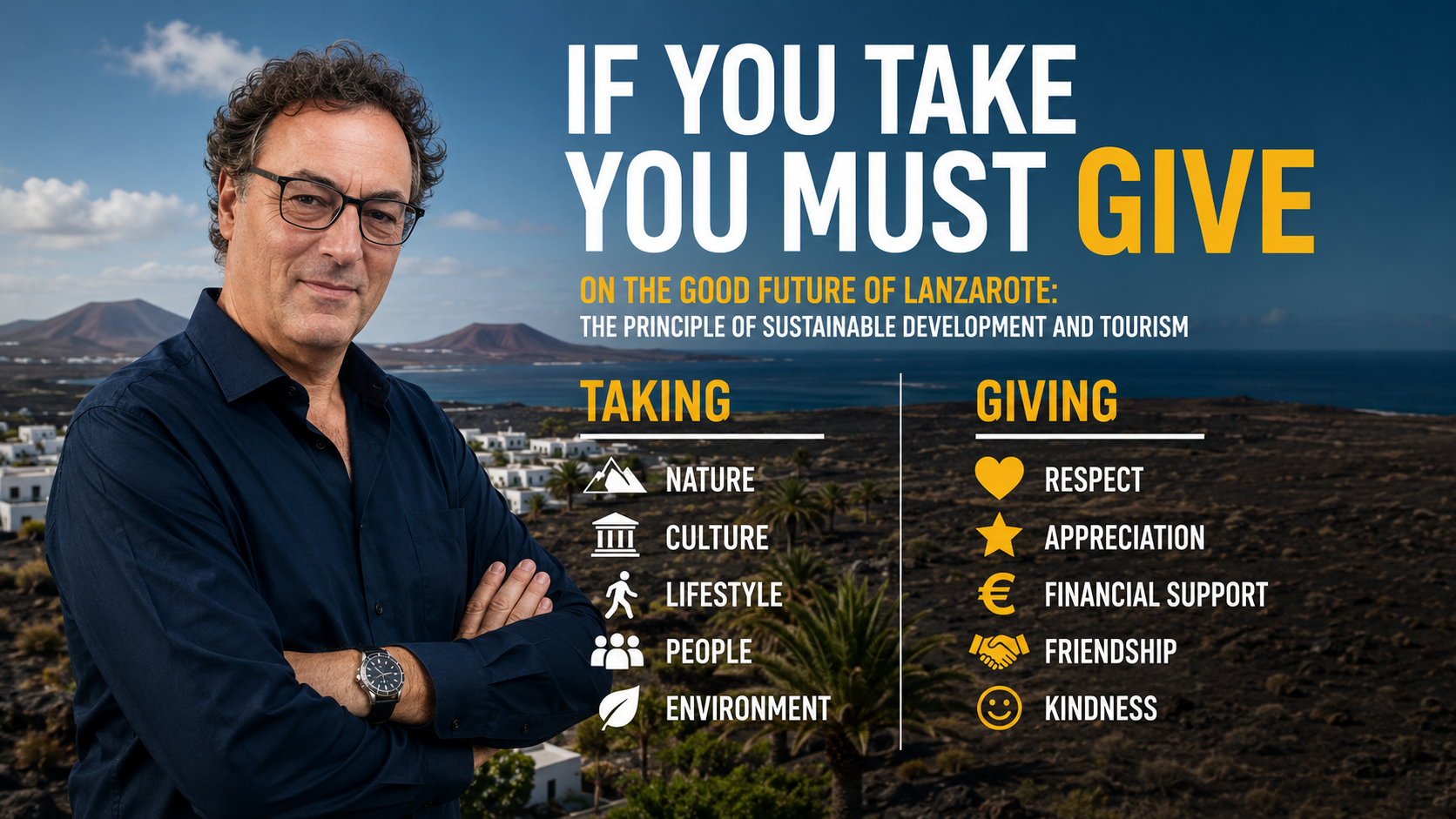
Gerd Leonhard

Review and Update: Gerd Leonhard's Activities in Lanzarote, Canary Islands: The Good Future?

Join the conversation on Lanzarote Gerd Leonhard and explore the future of the island through insights and personal experiences.

This review was done with various AI tools, such as NotebookLM, ChatGPT, Claude, Gemini etc - as a result, PLEASE BE SCEPTICAL::)

CONTEXT:

Gerd's Video: "The Good Future: Embracing the Four Revolutions, and the 5Ps: Reboot Lanzarote: La Isla Diferente!" (YouTube). and (La Voz de Lanzarote) and Gerd's recent review post.

The blunt answer

The last year has mostly validated Gerd's 2025 diagnosis — while the island has continued doing much of what you were warning against.

The biggest developments are:

1

Water has become a full-blown institutional crisis.

2

Housing has deteriorated badly.

3

Tourism hit a new record.

4

Holiday rentals exploded despite the new regulation.

5

The political system has adopted SOME of the language GERD WAS using — sustainability, regeneration, quality tourism, climate laboratory, etc.

6

There are VERY few genuine changes: the water service has been taken back into public hands, renewables are moving, and a visitor-funded "Retorna" mechanism actually started.

7

YET THERE IS little evidence of a fundamental change in the island's economic model.

On a positive note, the Cabildo explicitly says the idea of making Lanzarote a climate laboratory came from Gerd's Global South Forum presentation. (La Voz de Lanzarote)

1. WATER: this is the biggest story

This is not a talking point anymore. When Gerd spoke in June 2025, he warned about water as one of the island's existential problems. La Voz reported his call for action on water alongside climate, housing and mass tourism. (La Voz de Lanzarote)

April 2026

An official report found:

  • 55.4% of produced water being lost in the network
  • serious structural problems
  • recurring supply cuts
  • unresolved breakdowns
  • "maximum precariousness" in the service.

June 2026

The Water Consortium terminated Canal Gestión's concession and took the entire water service back into public hands after 13 years of private management. The decision was unanimous. (La Voz de Lanzarote)

The Consortium inherited:

  • more than 200 workers
  • 55% network losses
  • daily interruptions
  • problems in desalination plants
  • problems in wastewater treatment.

That is an enormous structural development. Gerd's diagnosis was strongly validated.

Island's response: finally substantial, but reactive and crisis-driven rather than strategic.

2. HOUSING: much worse

This is probably the second-biggest story.

La Voz's February 2026 analysis says:

~79,092 homes

Lanzarote has around 79,092 homes

~25% vacant

only 75% are used as residences; around 25% are classified as vacant

>10,000 holiday homes

more than 10,000 registered holiday homes

+27.7% price rise

housing prices rose 27.7% between January 2024 and January 2026

€2,974/m²

average price approached €2,974/m²

And in June 2026 the political debate had reached: "Who will be able to live in Lanzarote?" Five left-wing parties were holding a specific forum on the housing emergency, including holiday homes, speculation and touristification. (La Voz de Lanzarote). The really telling number is the holiday-home explosion.

June 2023 → January 2026

5,198 → 11,094

That's a 113.4% increase.

And this continued after the Canary Islands passed its new holiday-rental law. (La Voz de Lanzarote)

3. TOURISM: it didn't slow down — it broke another record

This is where the island has gone in almost exactly the opposite direction from the "less massification / more value / regeneration" argument.

2025

Lanzarote received:

3.46 million air visitors

— the highest number ever recorded.

And then add: >660,000 cruise passengers. So La Voz reports more than 4 million visitors in total in 2025. (La Voz de Lanzarote)

And here's the really interesting part:

Tourism revenue increased even while tourist numbers fell in accommodation statistics.

Hotels and tourist apartments generated:

€1.021 billion in 2025

— the first time the island's accommodation sector exceeded €1 billion.

Average rates rose 7.2%. So the tourism industry has discovered a perfectly rational economic response:

fewer nights + higher prices + higher revenue.

That is not necessarily bad economics. But it is not a transformation away from tourism dependency.

4. 2026 hasn't fundamentally changed that

January–May 2026:

1.462M

air tourists

January–May 2026

0.2%

below 2025

same period comparison

12.8%

above 2019

vs. pre-pandemic baseline

So there is no evidence of a major tourism reset. In fact, in the first quarter of 2026, 74.6% of visitors cited climate as a reason for choosing Lanzarote, followed by safety and tranquility. (La Voz de Lanzarote) That creates an interesting future problem:

5. Massification is now an explicit political problem

This has changed. In November 2025, La Voz reported that housing had become Lanzarote's number-one problem, with more than half of residents identifying it as their principal concern. And tourist/demographic overcrowding entered the island's top five problems.

Another survey showed housing, immigration, overcrowding, infrastructure and tourism management dominating public concerns. (La Voz de Lanzarote)

And politicians are now openly talking about the relationship between:

tourism → population growth → workers → housing → water → infrastructure.

In July 2026, Cabildo candidate Yoné Caraballo argued that the island's population had risen from just over 110,000 to more than 166,000, and explicitly attributed the growth to the tourism model's need for more workers. (La Voz de Lanzarote). That's actually a much more sophisticated public debate than "tourists are good/bad."

6. GERD's "FUTURE tax / give something back" idea: something actually happened (kinda)

This one deserves a nuanced GREEN… Gerd proposed that visitors should "give back what they take" — a mechanism to fund the island's future. La Voz reported that as one of the central elements of his June 2025 presentation. (La Voz de Lanzarote) A few months later, Lanzarote Futuro was proposing exactly this kind of contribution to finance the Climate Laboratory. (La Voz de Lanzarote). But then something more concrete happened.

Retorna

From 1 January 2026, the island's tourist centres began allocating:

€5 from every adult ticket
€2.50 from every child ticket

to a dedicated fund for strategic island projects involving areas such as:

  • energy
  • water
  • mobility
  • talent.

That's not the proposed island-wide ecotax. So I would not claim they implemented the idea. But it is the first genuinely concrete example I found of the principle:

Tourism revenue → dedicated funding for the island's future.

That is worth noting.

7. CLIMATE LABORATORY: Gerd's idea entered official policy?

This is the most directly attributable development. On 24 October 2025, the Cabildo unanimously approved a motion to turn Lanzarote into an Island Climate Laboratory. And the councillor responsible explicitly said the initiative arose from: Gerd Leonhard's Global South Forum presentation.

La Voz reported this directly. (La Voz de Lanzarote)

The proposed laboratory includes:

renewable energy

agroecology

water management

clean mobility

regenerative tourism

green employment

an Island Strategic Plan

an Island Climate Coordination Table

European/international funding

But here's the catch

We see evidence of a fully functioning laboratory with serious funding, projects, KPIs and delivery machinery.

So: Gerd's idea was politically picked up.

But:

The implementation is still questionable.

That's an AMBER, not a victory lap.

8. Renewable energy: real movement

This is another area where something tangible has happened. In July/August 2025 Lanzarote became the first Canary Island to establish renewable-energy acceleration zones.

The mapped area covers around:

3,100 hectares

for potential wind and solar development. (La Voz de Lanzarote)

That's significant. But don't overstate it. It's land designated for potential renewable development, not 3,100 hectares of renewable infrastructure.

So:

9. Digital / AI / innovation

Here the change is much smaller. The Digital Coworking Lanzarote exists and is backed by the Chamber, Cabildo and Incyde, with infrastructure intended for entrepreneurs, startups, audiovisual production and digital transformation. (La Voz de Lanzarote)

And there are technology/startup programs. But I don't see evidence that Lanzarote has become the international innovation magnet you envisioned.

It's still:

"we have a coworking space and programs."

Not:

"Lanzarote has become a global testbed for AI/climate/innovation."

That's a very important distinction.

10. The political language has changed — considerably

This is perhaps the most fascinating part. After Gerd's talk, La Voz reported the Tourism Minister saying: "Tourism is not the goal, but the tool to improve the lives of Canarians." And her presentation explicitly referred to People, Planet, Purpose and Prosperity — the 4Ps Gerd had just presented. (La Voz de Lanzarote)

The Cabildo then launched a campaign for "ethical and responsible tourism", saying Lanzarote needed not just any tourist but one who loves and respects the island. (La Voz de Lanzarote)

By FITUR 2026 the official positioning was:

sustainability + quality spending + diversification + social wellbeing + territorial protection. (La Voz de Lanzarote)

And Lanzarote was working with the UN Global Compact around sustainable tourism and climate action. (La Voz de Lanzarote)

The rhetoric has changed faster than the underlying system.

Because simultaneously:

  • tourist numbers hit records;
  • holiday homes doubled;
  • housing prices jumped 27.7%;
  • water infrastructure nearly collapsed;
  • overcrowding became a top public concern.

That's the contradiction.

So what actually happened in the year since Gerd's talk?

I'd summarize it this way:

1. The crisis became undeniable.

Water and housing are no longer "future issues." They're immediate political emergencies.

2. Tourism continued to expand.

2025 was a record year.

3. The externalities became much harder to ignore.

Housing, water, overcrowding and infrastructure are now directly linked to the tourism model in public debate.

4. Political language moved significantly toward your framing.

People / planet / purpose / sustainability / regeneration / quality tourism / climate laboratory.

5. Some actual mechanisms appeared.

Especially: public takeover of water; renewable acceleration zones; Retorna fund; public-housing spending; digital coworking.

6. But the core economic model has not changed.

That last point is crucial.

One slide: Lanzarote: One Year After "The Good Future"

conclusion:

Lanzarote has not "rebooted." It has recognized that it needs to reboot.

And that distinction is probably the most important thing that has happened in the last year. The island is now in a much more interesting — and dangerous — position than when you gave the talk: the contradictions you were pointing at are no longer abstract. They are colliding simultaneously: record tourism, housing scarcity, water failure, population growth, infrastructure stress and climate pressure.

At the same time, the political vocabulary has moved toward your vocabulary — but the underlying operating system has not yet changed.